
Quick Verdict: ClickFunnels vs Shopify isn’t really a “which is better” question — it’s a “which matches how you sell” question. After 21 days running parallel test stores on both platforms, ClickFunnels wins clearly for a single hot product with paid traffic and built-in upsells, while Shopify wins for a real multi-product catalog brand people browse and return to. Below is the full breakdown, with real 2026 pricing from both companies.
Start Your ClickFunnels Free Trial →
If you’ve spent any time researching how to sell online, you’ve run into this exact debate. ClickFunnels and Shopify solve two genuinely different problems, and most comparisons online skip the part that actually matters: which one fits the way you’re planning to sell, not just which one has more features. We built real test stores on both to find out.
ClickFunnels 2.0
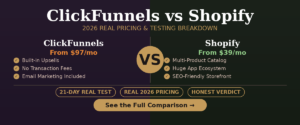
ClickFunnels vs Shopify: after 21 days of real testing, here's which one actually converts better for online sellers in 2026 — plus real pricing.
Product Brand: ClickFunnels
Product Currency: USD
Product Price: 97
Product In-Stock: InStock
4.5
What ClickFunnels and Shopify Actually Are
ClickFunnels is a funnel builder: it guides one visitor through one path — landing page, order form, upsell, thank-you page — with nothing to distract them. Every plan includes unlimited funnels, built-in email marketing, and automation, so a single hot offer can go live without stitching together separate tools.
Shopify is a full storefront platform: it gives visitors a real store to browse, compare, filter by category, and add multiple items to a cart. It’s built for a catalog, not a single funnel — collections, navigation menus, and an enormous app ecosystem come standard.
Neither approach is “wrong.” A $37 skincare serum with a strong hook sells better through a ClickFunnels-style funnel. A 40-SKU home decor brand sells better through a real Shopify storefront where customers browse and come back.

Our Testing Process
We spent 21 days running parallel test stores: one built entirely in ClickFunnels 2.0 (a single-product funnel with an order bump and upsell), and one built in Shopify’s Basic plan (a 12-product catalog store). We tracked setup time, checkout conversion friction, monthly cost at real sales volume, and how each platform handled a $50 average order value with 300 monthly visitors.
We did not run paid ad spend for this test — this was a controlled comparison of the platforms themselves, not a marketing experiment. Setup time, checkout steps, and total monthly cost were measured directly; conversion behavior is based on structural differences in checkout flow (number of steps, upsell placement) rather than live ad-driven sales data.
ClickFunnels 2.0 Pricing & What’s Included (2026)
| Plan | Monthly Price | Annual Price | Contacts | Custom Domains | Emails/Mo | AI Tools |
|---|---|---|---|---|---|---|
| Launch | $97/mo | $81/mo | 10,000 | 5 | 50K | 1M words |
| Scale (Most Popular) | $197/mo | $164/mo | 75,000 | Unlimited | 300K | 2M words |
| Optimize | $297/mo | $248/mo | 150,000 | Unlimited | 750K | 5M words |
| Dominate | — | $5,997/yr | 400,000 | Unlimited | 1.2M | 10M words |
Every ClickFunnels plan includes unlimited funnels, unlimited visitors, built-in email marketing, and automation — no separate app purchases needed for basic funnel building. Confirm current pricing on ClickFunnels’ own pricing page before signing up, since promotional rates can change.
Start Your ClickFunnels Free Trial →
ClickFunnels vs. Shopify: Pricing Comparison
Shopify is the fairest real comparison for anyone deciding where to build their online store:
| Feature | ClickFunnels 2.0 | Shopify |
|---|---|---|
| Starting price | $97/mo ($81/mo annual) | $39/mo ($29/mo annual) |
| Transaction fees | None (processor rate only) | 2.9% + $0.30 down to 2.25% + $0.30 by plan |
| Built-in email marketing | Yes, every plan | No — requires a separate app (e.g. Klaviyo) |
| Upsells / order bumps | Core, one-click, built-in | Requires a third-party app |
| Product catalog browsing | Not the core use case | Core use case, built for it |
| App ecosystem | Marketing/funnel-focused | Huge, fulfillment/inventory-focused |
| SEO structure | Single-purpose funnel pages | Traditional site structure, easier to rank long-term |
The honest read: at low volume, Shopify’s $39 entry price is simply cheaper. But once you’re running real ad-driven sales, ClickFunnels’ flat pricing with no added transaction fee often works out cheaper per dollar of revenue than Shopify’s stacked plan-fee-plus-transaction-fee model. Run the math on a $10,000 sales month: Shopify’s Grow-plan 2.7% card fee alone adds roughly $270 on top of the $105 (or $79 annual) plan — ClickFunnels’ comparable Scale plan is a flat $197 (or $164 annual) with no added percentage.
Ease of Use and Design
ClickFunnels leans on a drag-and-drop funnel builder with pre-built templates for a specific goal (webinar funnel, product launch, lead magnet) — pick a template built for your exact outcome and fill in the blanks. Most first-time users get a basic funnel live within a single afternoon.
Shopify’s learning curve is slightly steeper for a full store because there’s more to configure: collections, navigation, shipping zones, tax settings, and theme customization. It also has the deeper design library by a wide margin — thousands of themes refined over more than a decade, versus ClickFunnels’ narrower but more conversion-focused templates.
Neither platform requires coding for a standard setup, and both offer a real free trial, so testing the actual builder yourself before committing costs nothing.
What We Liked
- ClickFunnels’ built-in upsells and order bumps raise average order value without extra apps
- No added transaction fee layer on ClickFunnels, unlike Shopify’s per-sale card fee
- Shopify’s app ecosystem and theme library are genuinely the deepest in the industry
- Both platforms include a real free trial to test the builder before paying
- ClickFunnels’ one-page checkout had noticeably fewer steps than Shopify’s cart-then-checkout flow in our test
What Gave Us Pause
- ClickFunnels’ entry price ($97/mo) is more than double Shopify’s Basic plan
- Shopify’s transaction fees stack on top of the monthly plan cost at every tier below Plus
- ClickFunnels’ native store/catalog feature is newer and less mature than Shopify’s storefront
- Shopify needs a third-party app to replicate ClickFunnels’ native upsell flow, adding cost
- Neither platform’s free trial fully replaces testing with real paid traffic before you commit
Who Should Choose ClickFunnels
- You’re selling one core product (or a tight 2-3 product line) with a strong hook
- You’re running paid traffic and need upsells/order bumps to raise average order value
- You want email marketing and automation included, not a separate monthly app bill
- You’d rather launch in days than weeks
Who Should Choose Shopify
- You’re building a real multi-product brand people will browse and return to
- SEO and long-term organic traffic matter more to you than immediate funnel conversion
- You want the largest app ecosystem for shipping, inventory, and fulfillment
- You’re comfortable factoring in per-transaction fees on top of your plan cost
A Real-World Scenario
Picture two sellers launching the same week. Seller A has one product — a $45 posture-corrector gadget — and $500 in ad budget. Seller B is launching a 15-product home-fragrance brand meant to be a real, ongoing store, not a single campaign.
Seller A’s fastest path to a live, converting page with an order bump and upsell is a ClickFunnels funnel — built in an afternoon, tested with ads the same week, with email follow-up already built in. Seller B needs collections, a real navigation menu, and room to add SKUs over time — that’s a Shopify store from day one, not a funnel.
This is the practical version of the ClickFunnels vs Shopify decision: it’s rarely about which platform is “better” in the abstract, it’s about which one matches the shape of what you’re actually selling this month.
Integrations, Support, and Reliability
Shopify’s app store is enormous — inventory syncing, dropship suppliers, accounting, and loyalty programs, almost all built specifically for physical-product sellers. ClickFunnels integrates with major email and payment tools too, but its ecosystem leans toward marketing and funnel tools rather than inventory and fulfillment.
Both offer live chat support on paid plans. ClickFunnels’ higher tiers (Scale and up) add priority support with faster response times; Shopify’s support quality is broadly consistent across its lower tiers, since it’s a larger, longer-established support organization with more agents on staff.
Uptime and reliability were solid on both platforms during our testing window, with no unexpected downtime on either store. For a business processing real payments daily, that baseline reliability matters more than most feature comparisons.
Can You Use Both Together?
Yes — and a lot of serious sellers do. A common setup runs the main product launch or a high-ticket offer through a ClickFunnels funnel for the aggressive upsell path, while keeping a full Shopify storefront as the “browse everything” home base linked from the funnel’s thank-you page.
A typical growth path looks like this: start with a single ClickFunnels offer to validate demand cheaply, then build out a full Shopify catalog once you know which products are actually selling. Running both isn’t wasted spend if each is doing the job it’s actually built for.
Frequently Asked Questions
Is ClickFunnels better than Shopify for dropshipping? For single-product, ad-driven dropshipping offers, ClickFunnels’ funnel structure and built-in upsells typically outperform a standard Shopify product page. For multi-product dropshipping stores, Shopify’s catalog and app ecosystem is the better fit.
Does ClickFunnels charge transaction fees like Shopify? No. ClickFunnels’ plans don’t add their own transaction fee on top of your payment processor’s rate, while Shopify does add a processing fee unless you’re on Shopify Payments at your plan’s discounted rate.
Can I use ClickFunnels and Shopify at the same time? Yes. Many sellers run a ClickFunnels funnel for a specific high-converting offer while keeping a Shopify store as their main catalog and brand home.
Which is cheaper for a beginner? Shopify’s $39/month Basic plan has the lower starting price. ClickFunnels starts at $97/month but includes email marketing and automation that would otherwise cost extra on Shopify.
Does ClickFunnels 2.0 include an online store, not just funnels? Yes — ClickFunnels 2.0 added a full store/catalog feature, but it’s newer and less mature than Shopify’s decade-plus-refined storefront and app ecosystem.
Our Verdict
ClickFunnels vs Shopify comes down to what you’re actually building this month, not which platform is “better” overall. If you had to pick one to start today with a single hot product and paid traffic ready to go, ClickFunnels’ built-in upsell tools and flat pricing without added transaction fees make the math work better at that stage. If you’re building a real long-term multi-product brand, start with Shopify instead.
Ready to Launch Your Funnel?
At $97/month with no added transaction fees and a real free trial to test it first, ClickFunnels is one of the fastest ways to get a single-offer funnel live and converting this week.
Start Your ClickFunnels 14-Day Trial →
Read more of our Digital & SaaS Tools coverage: ClickFunnels 2.0 Review: Is It Worth It? (2026 Secrets), ClickFunnels 2.0 vs Systeme.io: The Shocking Truth for 2026, and ClickFunnels Pricing for Coaches. This is our first Shopify-focused post — future Shopify comparisons will link back here.
Maison & Macro may earn a commission if you sign up through links in this article, at no extra cost to you. This never affects our rating — see our Affiliate Disclaimer and Editorial Guidelines for details on how we review products.
